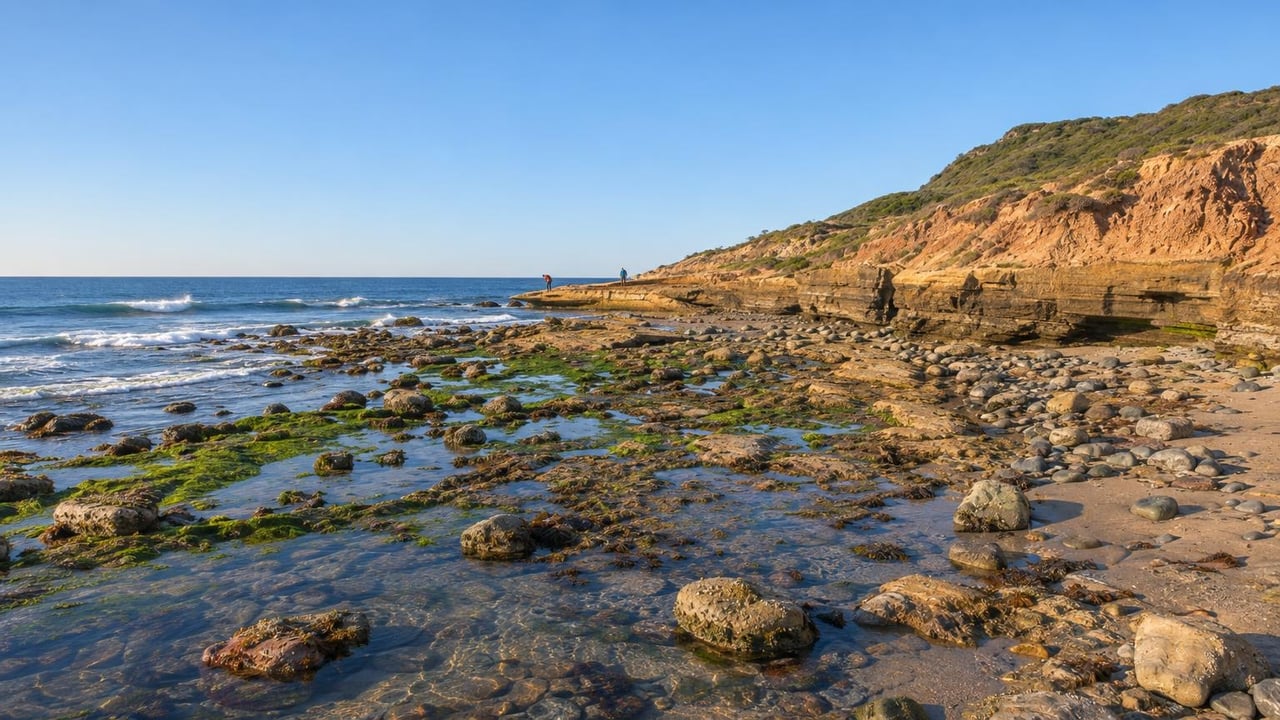
Cabrillo National Monument is closed today for Thanksgiving. It closes on one other day of the year, Christmas. NOAA predicts a low of minus 1.57 feet at Point Loma at 4:34 p.m. on December 25, one of the lowest tides of the season, and it comes on a day the park is closed.
That timing shows how the tidepools at the tip of the peninsula work this time of year. The National Park Service calls late fall and winter the best tidepool season, because the extreme lows that expose the most marine life come during daylight. The tidepool area closes at 4:30 p.m., though, and each series of minus tides arrives a little later every afternoon. The low tide and the closing time decide the season together, and this winter they leave a short list of afternoons.
The 4:30 Gate Decides the Season
The park's guidance is simple. A tide of 0.7 feet or lower is the best chance to explore the pools. A good visit runs from about two hours before low tide to about two hours after, and the tidepool area closes at 4:30 p.m. even though the park stays open until 5.
A low at 1:30 p.m. leaves the whole four-hour window inside park hours. A low at 3:48 p.m. leaves only the falling half, so you arrive while the water is still pulling back and leave near its lowest point. Once the low passes 4:30, the best water of the day comes after the area has closed. NOAA's predictions for its Point Loma station show this every few weeks. A run of minus tides starts around midday, gets lower and later each day, and then slips past the closing time.
Low Tides That Fit Before Closing
These are NOAA's predicted lows at Point Loma for the rest of the season, kept only where the low comes in daylight and before the tidepool area closes. They are predictions, so check them again the week you plan to go.
- Sunday, December 6, through Wednesday, December 9. The low moves from 2:02 p.m. on Sunday to 3:43 p.m. on Wednesday and stays between minus 0.39 and minus 0.58 feet all four days. On Thursday, December 10, the low comes at 4:18 p.m., 12 minutes before closing.
- Sunday, December 20, through Thursday, December 24. This is the deepest run of the month. It starts at minus 0.18 feet at 12:47 p.m. on Sunday and reaches minus 1.37 feet at 2:18 p.m. on Tuesday the 22nd, minus 1.66 feet at 3:03 p.m. on Wednesday the 23rd, and minus 1.73 feet at 3:48 p.m. on Christmas Eve. The Christmas Day low falls on a closed day, and the December 26 low, at 5:20 p.m., comes after the park has closed.
- Saturday, January 2, through Thursday, January 7. A milder set, with lows between 12:41 and 3:28 p.m., from 0.18 feet down to minus 0.68 feet.
- Tuesday, January 19, through Friday, January 22. The lowest daylight water of the winter. The low is minus 1.13 feet at 1:26 p.m. on Tuesday, minus 1.58 feet at 2:09 p.m. on Wednesday, minus 1.81 feet at 2:49 p.m. on Thursday the 21st and minus 1.80 feet at 3:28 p.m. on Friday. Saturday the 23rd bottoms out at 4:06 p.m., 24 minutes before closing, and the January 24 low comes after the area closes.
- Saturday, January 30, and Sunday, January 31. The season ends with two shallower lows, 0.63 feet at 11:33 a.m. on Saturday and 0.19 feet at 12:31 p.m. on Sunday. Both are under the park's 0.7-foot mark, and both fall on a weekend.
Most of the strongest afternoons fall on weekdays. That works in a nearby resident's favor, because coming back on short notice costs little.
A Weekday Low Is a Quieter Low
The park has counted. As the park volunteers' blog CNM VIP Voice reported in 2022, infrared trail counters at the Coastal Trail entrances by the Tidepool Parking and Coast View Parking areas recorded visits from 2011 to 2020. Over that decade, weekend visits to the coastal area were 110 percent higher than midweek visits, and tide level had no correlation with how many people came. Weekend crowds come whatever the tide is doing, and most visitors don't plan around the tide at all. A Tuesday at minus 1.37 feet is likely to be quieter than a Saturday with nothing uncovered.
On weekends the NPS says parking fills quickly and suggests arriving close to the 9 a.m. opening. When the tidepool lot is full, rangers may close the access road for a while, usually for about 30 minutes. On a weekday afternoon in the December 20 run, that matters less.
You can also reach the pools on foot from the top of the park. The Oceanside Trail opened on April 24, 2024, and links the Whale Watch and Kelp Forest Overlook area to the tidepools, so walkers no longer need the narrow road shoulder, as FOX 5 San Diego reported when it opened. The park's trail page calls it steep and strenuous and lists its hours as 9 a.m. to 4 p.m., half an hour earlier than the tidepool area. On a 3:48 p.m. low, plan your walk around the trail's closing time as well as the tide.
As of 2026, the NPS fee schedule lists entry at $20 per private vehicle and $10 per person on foot or by bicycle, and the Cabrillo annual pass at $35. If you plan to drive in for one December run and one January run, the annual pass costs less than two vehicle entries.
What the Lowest Water Uncovers
The difference between a 0.6-foot afternoon and a minus 1.8-foot afternoon is which part of the shore you can see. The NPS divides Cabrillo's rocky intertidal into High, Middle and Low zones. Barnacles, limpets, chitons, crabs and mussels live in the High zone. The Middle zone has anemones, keyhole limpets, black tegula snails, Kellet's whelks, sandcastle worms, surfgrass and algae. Octopus, sea stars, nudibranchs, sea hares, spiny lobsters, urchins and fish live in the Low zone, which the park's tidepool guide says is reachable only at the lowest tides. The December 22 to 24 and January 20 to 22 afternoons are when the Low zone is exposed.
The NPS intertidal field guide names the residents. The two-spot octopus, Octopus bimaculoides, shelters in holes and crevices. The knobby sea star, Pisaster giganteus, holds onto rocks in the lower intertidal, and bat stars tuck under rocks or into sandy spots. The Hopkins rose nudibranch, Hopkinsia rosacea, turns up in seagrass and low pools. The owl limpet, Lottia gigantea, is the largest true limpet on the Pacific Coast. After last January's minus tides, the park volunteers' blog, CNM VIP Voice, reported that nudibranchs were "out in force" and posted photos of two-spot octopuses, spiny lobsters, sea hares, brittle stars and red rock shrimp.
The shore is managed in sections. Zones I and II are open, and Zone III has been closed to the public since November 1996, apart from occasional visits by researchers and U.S. Coast Guard personnel. That same month, on November 6, 1996, the park started its Tidepool Protection, Education, and Restoration Program, the volunteer effort that encourages safe exploration and helps protect the rocky intertidal. The water along this part of the coast is also the Cabrillo State Marine Reserve, which the California Department of Fish and Wildlife lists at 0.39 square miles along one mile of shoreline.
The park has monitored these pools since 1990. Its March 2019 condition assessment, based on surveys through fall 2017, found that average owl limpet size had declined over time across the monitored zones. It found no indication that visitors caused the decline, because the most-visited and least-visited zones did not differ in average limpet size. The NPS also recommends sturdy closed-toe shoes with good grip for the short scramble down from the parking area.
The January Set Lines Up With the Whales
The deepest run of the winter also falls during peak gray whale season. The NPS says most gray whales migrating south from Arctic feeding grounds toward Baja pass San Diego in late December, January and February, with the best viewing in mid-January. Whales can be seen from mid to late December through March. The minus tides of January 19 to 22 fall right in that peak.
The park's recommended viewing spots are the Kelp Forest, or Whale Watch, Overlook and the heights near the Old Point Loma Lighthouse. Face west and scan from the kelp beds out to the horizon, and bring binoculars. The Oceanside Trail starts at that overlook area and leads down to the pools, so on Wednesday, January 20, with a 2:09 p.m. low, you can spend late morning at the overlook, walk down, and still have a couple of hours on the rocks before the 4:30 closing.
For whale watching with a crowd, the Cabrillo National Monument Foundation has set its 2027 Whale Watch Festival for Saturday, February 6, from 9 a.m. to 4 p.m., with exhibitors, speakers, activities and whale watching from land. The foundation's recap of the 2026 festival counted more than 4,100 visitors. Volunteers helped spot migrating whales from the Whale Watch Overlook that day, and the auditorium talks included "Bering Sea to Baja: Status of the Gray Whale Population." That is a Saturday on the busier side of the park's weekend count. The quieter whale days come two weeks earlier, on the weekday afternoons in the January list above.
A morning at the Whale Watch Overlook and an afternoon on the rocks below it are part of everyday life on the Point Loma peninsula. If you're thinking about how close your own home sits to that coastline this winter, Craig Lotzof & Associates would be glad to have that conversation. Schedule a private market consultation.